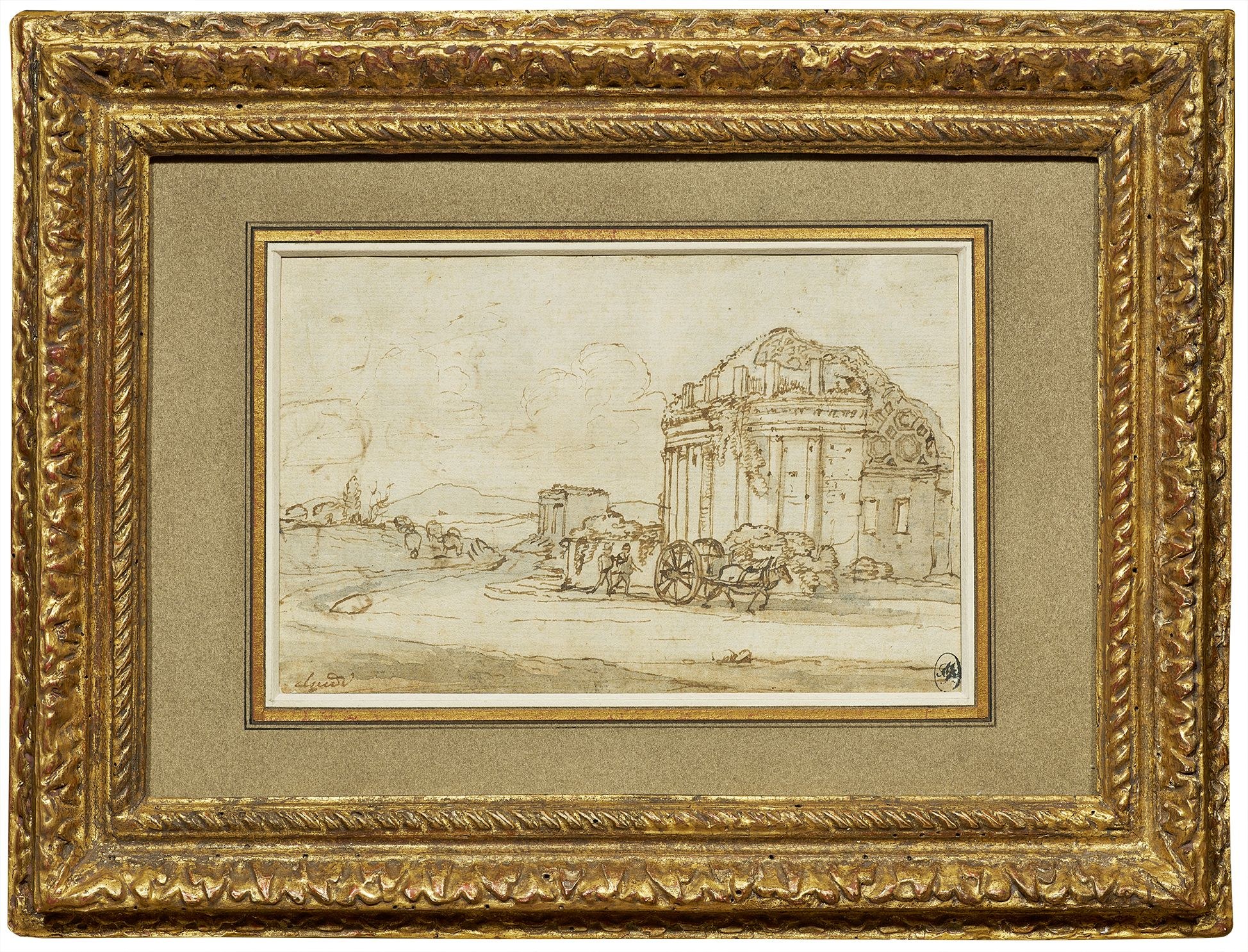
Claude Gellée, conocido como Claude Lorrain.
Chamagne, hacia 1600 - Roma, 1682
- Title
- Landscape with an Ancient Mausoleum, En torno a 1639
- Technique
- Brown pen and brown and gray ink wash over graphite underdrawing.
- Dimensions
- 110 x 170 mm (23,6 x 31,2 cm con marco)
- Category
- Old Master Paintings and Sculpture
Provenance: Michel Gaud (collector’s stamp lower right, Lugt 3482).
This study depicts a landscape typical of the Roman countryside: an ancient mausoleum in the foreground, before which a cart passes, followed by two peasants. While the technique, a pen drawing over graphite underdrawing, finished with brown and gray ink washes, and the signature inevitably evoke the art of Claude Lorrain, additional evidence found on the reverse of the sheet has led us to consider this previously unpublished drawing as a work by the master himself.
The motif of the mausoleum is sketched in pen on the reverse, employing a technique that can be found in several other drawings by Lorrain. Also present is a study of three figures, which may be regarded as preparatory for Lorrain’s painting The Embarkation of Saint Paula (Museo del Prado, Madrid). This connection supports the attribution of the drawing to the artist and suggests a date of execution around 1639.
Stephane Renard Fine Art
Stand: Stand 5C02
Art has always been his passion. After an initial professional career in the banking sector, Stephane decided in 2020 to place this passion for art at the center of his life and founded STEPHANE RENARD FINE ART. The gallery primarily exhibits paintings and drawings, alongside a selection of sculptures. His preferred period ranges from the Italian Renaissance to Romanticism (1550-1840), although he also presents more recent works on paper by major 20th-century artists.
For this reason, he has chosen to remain a generalist, offering an eclectic selection of discoveries and personal favorites. Rather than focusing on a particular period or school, he seeks above all works distinguished by the quality of their execution and their emotional impact. He also strives to place each work within its historical and artistic context through active collaboration with art historians.