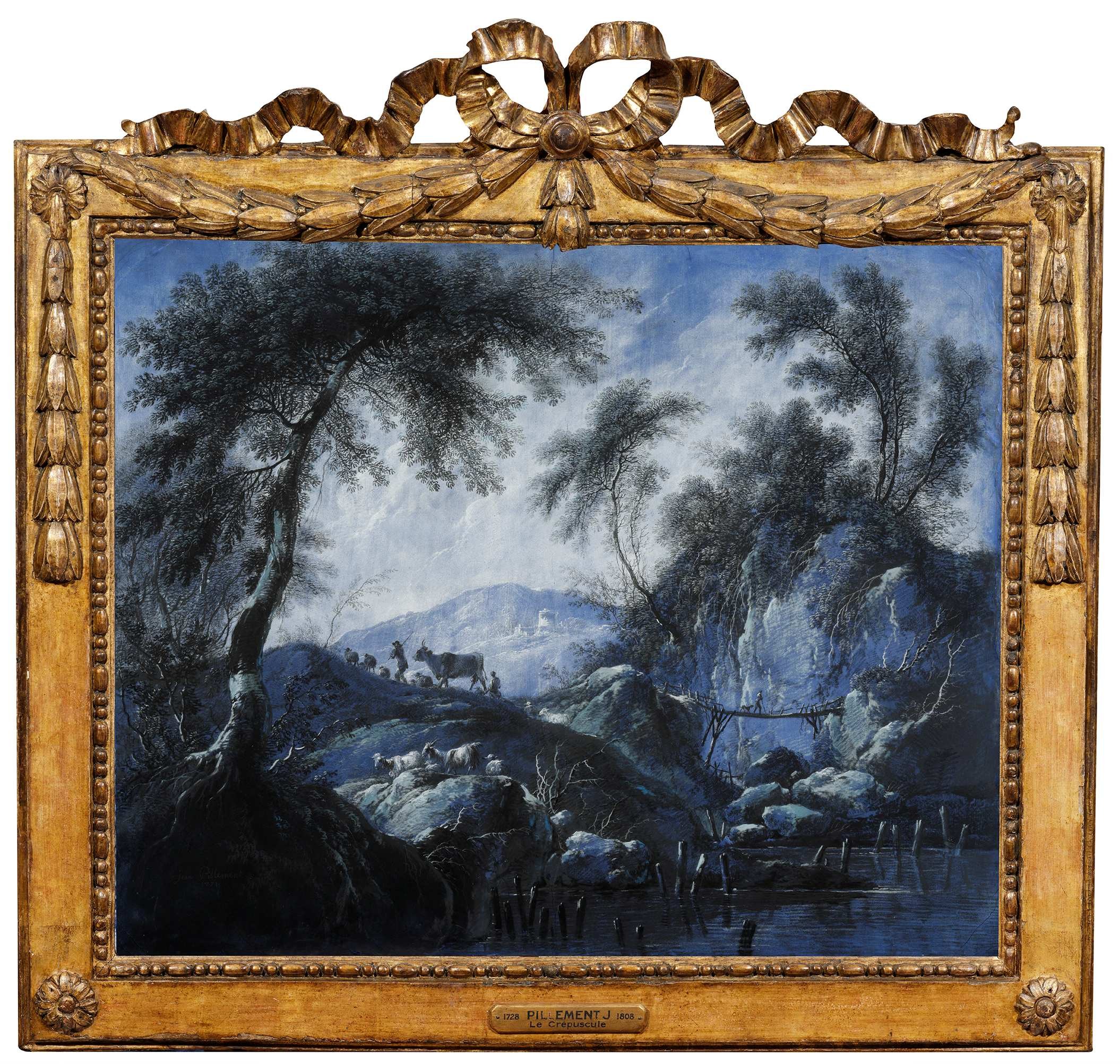
Jean Pillement
Lyon, 1728-1808
- Title
- The Dusk, 1771
- Technique
- Tempera (glue-based paint), pastel, and gouache on canvas.
- Dimensions
- 56 x 69,5 cm (86 x 82 cm con marco)
- Category
- Old Master Paintings and Sculpture
Provenance: Private collection (Paris); in the same family since the early 20th century.
This pair of large-scale landscapes, painted in blue tonalities, demonstrates Pillement’s remarkable talent for depicting atmospheric scenery, here bathed in the distinctive light of dawn and dusk. Set within an imaginary landscape composed of rocky outcrops covered with vegetation, the artist portrays in these two paintings the everyday life of a pair of shepherds: arriving at the riverbank at daybreak and returning home with their livestock at sunset. The presence of the same suspension bridge in both scenes suggests that they may in fact represent the same valley viewed from two different vantage points.
The unique light that characterizes the beginning and end of a warm summer day is rendered through a particularly dazzling trompe-l'œil technique: glue tempera, a form of tempera favored by Pillement, which evokes the delicacy of pastel while avoiding its vulnerability to light exposure, enhanced with touches of pastel and gouache. This pair of paintings, one of which is dated 1771, was probably executed during the artist’s stay in Paris. However, they were most likely inspired by landscapes Pillement sketched during his first stay in Portugal; indeed, their bluish hues anticipate the canvases he would produce during his second Portuguese period beginning in 1780.
Stephane Renard Fine Art
Stand: Stand 5C02
Art has always been his passion. After an initial professional career in the banking sector, Stephane decided in 2020 to place this passion for art at the center of his life and founded STEPHANE RENARD FINE ART. The gallery primarily exhibits paintings and drawings, alongside a selection of sculptures. His preferred period ranges from the Italian Renaissance to Romanticism (1550-1840), although he also presents more recent works on paper by major 20th-century artists.
For this reason, he has chosen to remain a generalist, offering an eclectic selection of discoveries and personal favorites. Rather than focusing on a particular period or school, he seeks above all works distinguished by the quality of their execution and their emotional impact. He also strives to place each work within its historical and artistic context through active collaboration with art historians.