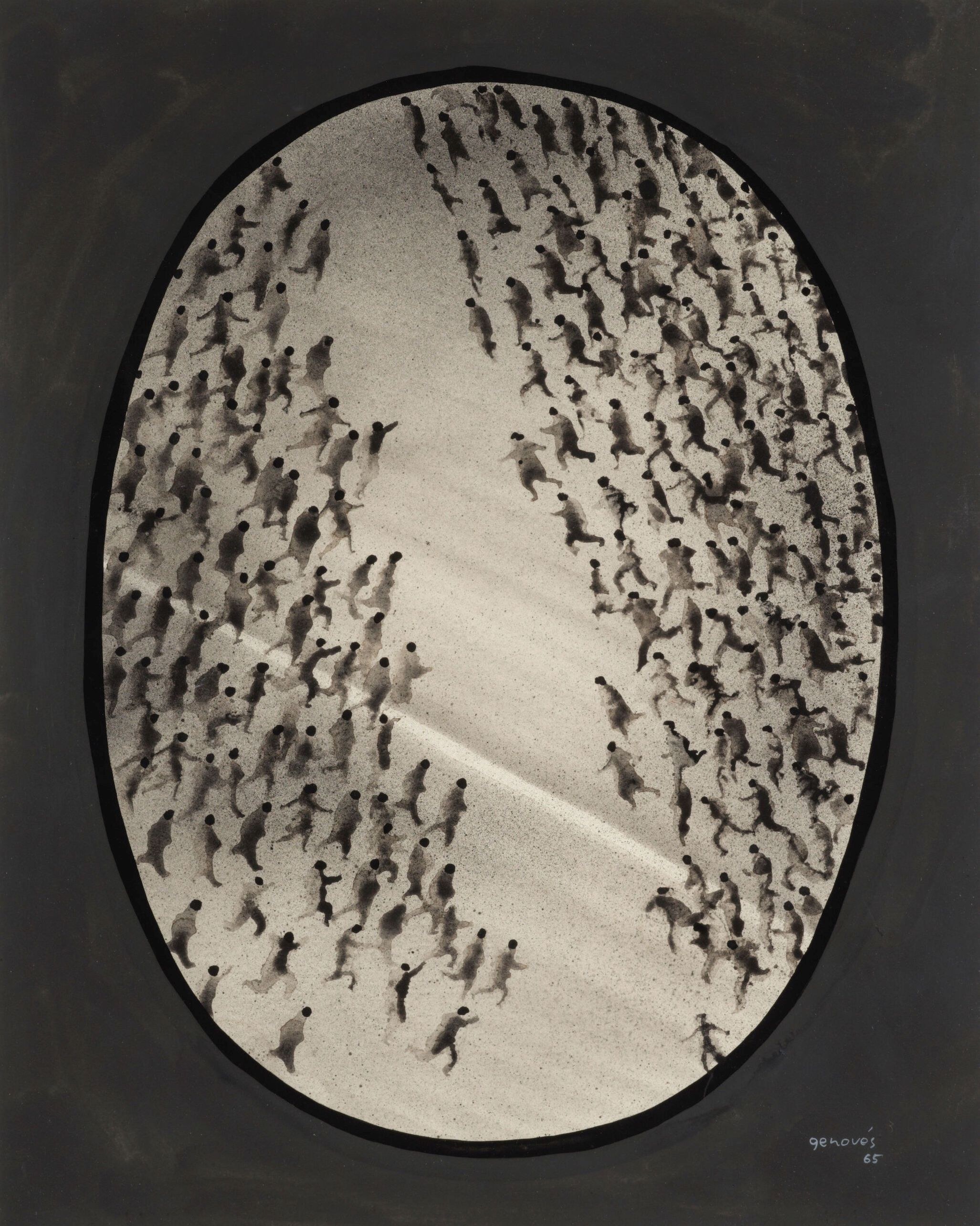
Juan Genovés
1930 - 2020
- Title
- Encuentro, 1965
- Technique
- Gouache and India ink on paper.
- Dimensions
- 62.6 x 50 cm
- Category
- Painting and Sculpture (19th and 20th Centuries)
Key work from the artist’s early political period. It depicts two crowds seen from above, moving toward a meeting point, separated by a dividing line that functions as a prohibition and enclosed within an oval that reproduces the telephoto lens view of power. Created in 1965, it is the direct precursor to The Embrace (El abrazo, 1974-76), the iconic work of Spain’s Transition to democracy, which embodies precisely this idea: a crowd, viewed from a distance and from above, moving toward a point of encounter.
In 1965, Genovés does not paint the embrace itself; he paints the moment immediately before it: two Spains rushing toward a meeting point but not yet touching. Eleven years later, in 1974-76, that gap is finally closed and The Embrace is born, the work that became an emblem of the Spanish Transition, was installed in the Congress of Deputies, and was later transformed into a sculpture in Plaza de Antón Martín. Encounter (Encuentro) is the direct antecedent of the most famous work in 20th-century Spanish art. It is not a small sketch, but a medium-format work conceived as a finished composition rather than a preparatory study.
In 1965, Genovés held a solo exhibition at the Dirección General de Bellas Artes (today part of the National Library of Spain in Madrid), an exhibition widely regarded as a genuine provocation to the dictatorship. It proved so controversial that the curator lost his position, and Genovés was not offered another solo exhibition in a public institution until 1983. In 1966, he participated in the 33rd Venice Biennale, where he received an Honourable Mention, and in 1967 he exhibited at Marlborough London. Works from the period 1965-1975 were later reunited in major exhibitions, including Juan Genovés: Reconsidered at Marlborough New York (2022), a chronological selection spanning 1965 to 1975 and conceived as a tribute to his landmark 1967 exhibition at Marlborough London, and Juan Genovés: Crowds at the Museum of Moscow (2019), a retrospective featuring more than ninety works devoted to the theme of crowds.
Galería Jorge Alcolea
Stand: Stand 5D09
With an established career spanning from 1989 to the present, Galería Jorge Alcolea has remained committed to showcasing the finest modern and contemporary painting. In its early years, the gallery focused on exhibiting and supporting the work of emerging artists, many of whom have since achieved national and international recognition. Over time, it has preserved this spirit, combining a roster of well-established artists with a strong commitment to promoting promising young talents in Spanish painting.
The Alcolea name has been linked to the art world since 1973, when Alfonso Alcolea and Teresa Albero inaugurated Sala Nonell in Barcelona. Dedicated to Modern Art, the gallery exhibited works by artists such as Marià Fortuny, André Masson, Grau Sala, Pablo Picasso, Juan Gris, Santiago Rusiñol, Joaquín Mir, and Ramón Casas, presenting them from New York to Buenos Aires, cities where the gallery maintained branches. In November 2019, the space reopened as Jorge Alcolea – Nonell with the exhibition The Pheasant Hunt, curated by Enrique Juncosa.
Jorge Alcolea belongs to the second generation of a family of art dealers, with a presence in Barcelona since 1973 and his own gallery in Madrid since 1987.
Over the course of twenty years, he has participated in international art fairs in more than twenty countries. He has also organized fairs, art events, and exhibitions, and is currently the founder and director of the Salón de Arte Moderno, now in its eighth edition.
He serves as a board member of the Spanish Federation of Antique Dealers.
One of his most recent projects was the exhibition at the Círculo de Bellas Artes of the original stage backdrops for Dalí’s Bacchanale.