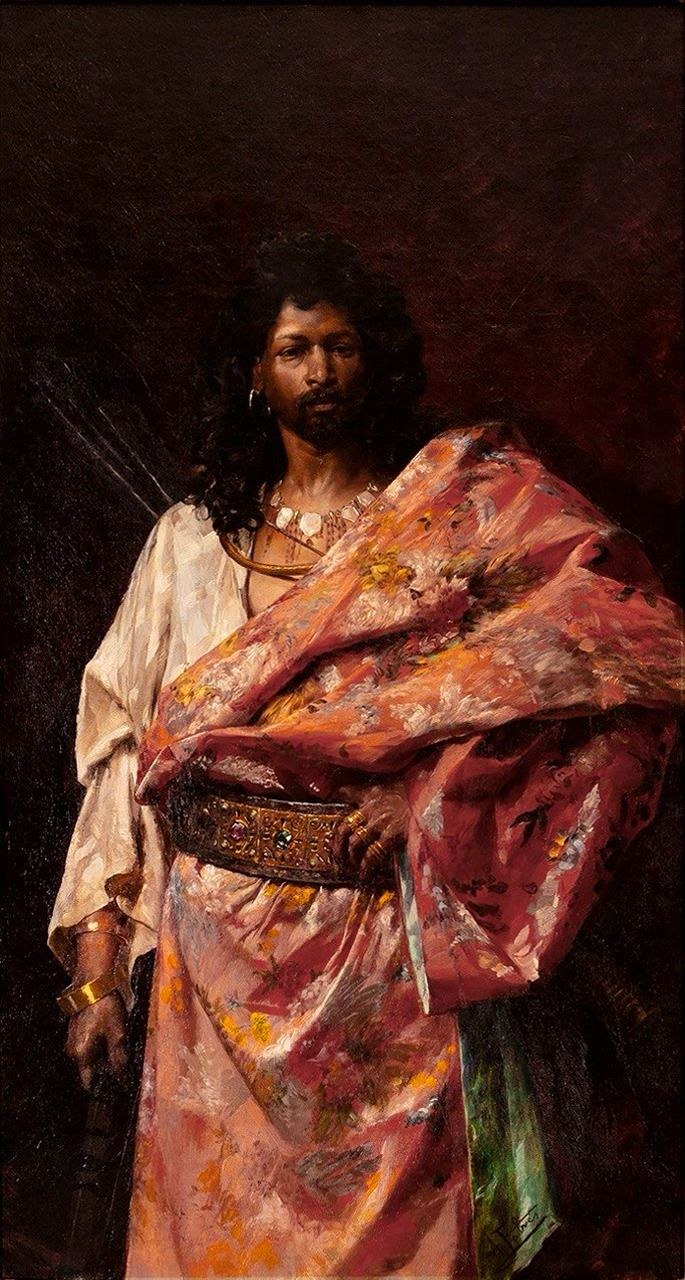
ANTONIO MARÍA FABRÉS Y COSTA
Barcelona, 1854 – Roma, 1938
- Title
- Guerrero nubio, Hacia 1880
- Technique
- Oil on canvas
- Dimensions
- 92 × 50 cm
- Category
- Painting and Sculpture (19th and 20th Centuries)
A depiction of the journey to the East and Europe’s fascination with other cultures
The painting *Nubian Warrior*, created around 1880 by Antonio María Fabrés y Costa (Barcelona, 1854–Rome, 1938), is a significant example of late-19th-century Spanish Orientalist painting and offers an interesting connection to the theme of the Grand Tour.
During the 19th century, the traditional concept of the Grand Tour—associated primarily with the educational journey through Italy and Greece and the study of classical antiquity—gradually broadened its horizons. The eastern Mediterranean, Egypt, and North Africa began to occupy a prominent place in the itineraries of European travelers, artists, and collectors. The fascination with these regions’ landscapes, monuments, traditions, and people gave rise to a new visual culture that found one of its most representative expressions in Orientalist painting.
It is within this context that Antonio María Fabrés’s body of work is situated. After receiving a scholarship in 1875 to complete his artistic training in Rome, the painter spent much of the following years there developing his career. Influenced by Mariano Fortuny’s Orientalist tradition, Fabrés cultivated a style of painting of extraordinary technical richness, characterized by attention to detail, meticulous rendering of fabrics and objects, and a particular focus on the depiction of figures and settings of Eastern inspiration.
In Guerrero Nubio, the artist depicts a solemn-looking male figure dressed in North African- and Eastern-inspired attire. Particularly striking are the rich colors of the cloak, the ornamentation of the jewelry and the belt, as well as the contrast between the figure and the dark background, which focuses all attention on the character’s presence. The execution reveals Fabrés’s technical virtuosity and his ability to transform textile and ornamental details into fundamental elements of the composition.
The work offers insight into one of the most characteristic aspects of 19th-century European culture: the interest in territories located beyond the traditional routes of the Grand Tour. The expansion of travel to the East, the development of travel literature, and the growing knowledge of Egypt and North Africa fueled a fascination that transcended the realm of travel to become part of collecting and the visual arts.
For all these reasons, this painting is a particularly fitting piece for the Feriarte 2026 Grand Tour exhibition, as it represents the Orientalist aspect of that travel culture and the expansion of the European imagination toward other geographies and civilizations during the 19th century.
This work reveals how travel, encounters with other cultures, and a fascination with the East transformed the artistic perspective and tastes of European collectors.
Atril Project
Stand: Stand 5C09
Professional advice and bespoke solutions for acquiring, managing, valuing and selling works of art. Combining market expertise, scholarly research and an international network, we help collectors, institutions and estates navigate every stage of the art market with confidence, discretion and informed decision-making.