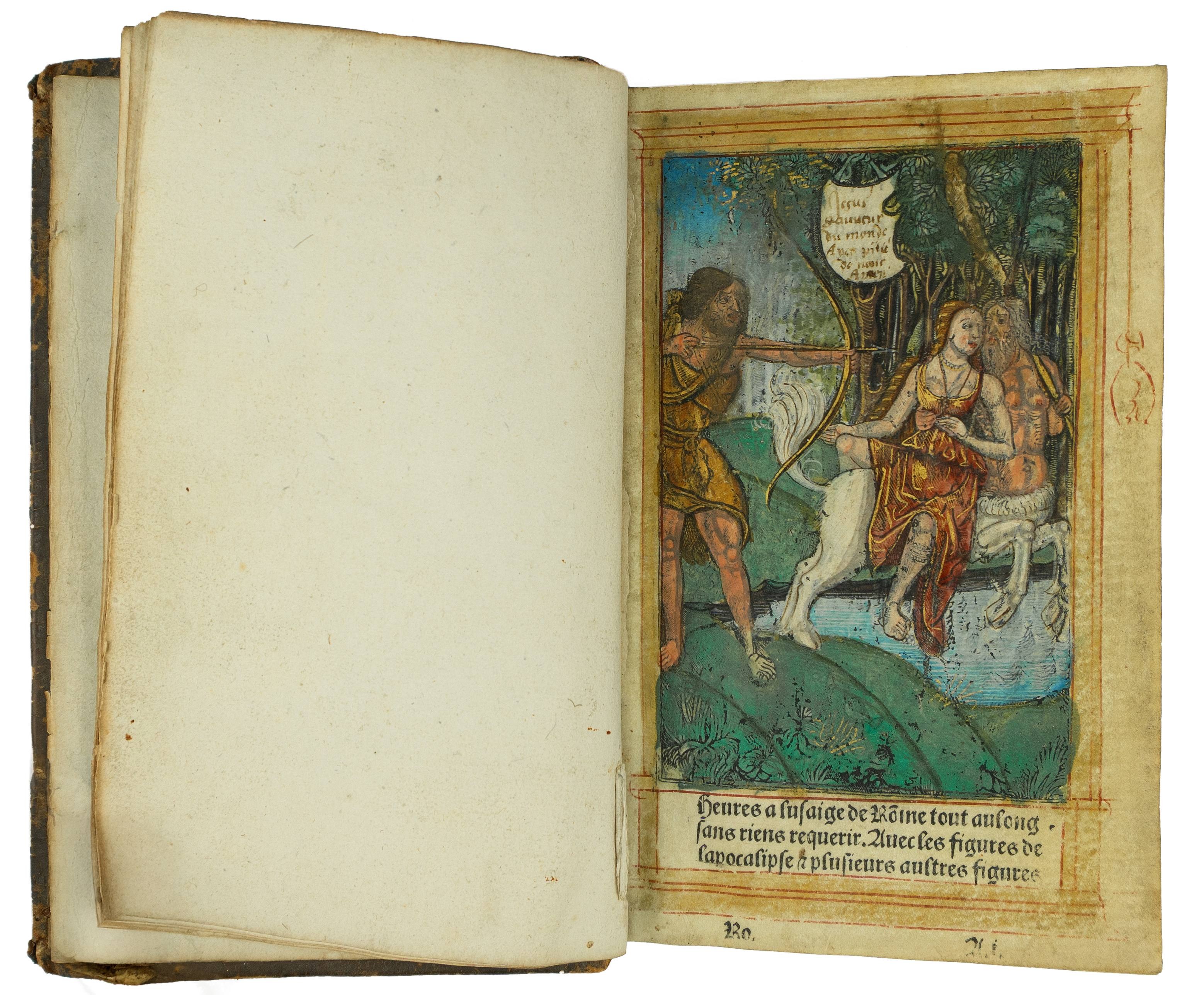
Germain Hardouyn
- Title
- Book of Hours According to the Roman Rite, París, c. 1514
- Technique
- 97 folios 27 engravings hand-gilded with gold Leather binding (17th century). Matching slipcase (21st century)
- Dimensions
- 17 x 11 cm
- Category
- Antiquarian Books
Private collection, Spain
A testament to the transition from the medieval manuscript to the Renaissance printed book. Produced on fine parchment, it combines typographic and engraving techniques with rich hand illumination, masterfully reproducing the exquisite medieval manuscripts. It reflects the new elites’ taste for devotional works of high artistic quality.
Germain Hardouyn (active 1500–1541), a great master of the French Renaissance Book of Hours, was both a printer and an illuminator—a dual role that was rare at the time.
Moleiro - El arte de la perfección
Stand: Stand 5A09
Moleiro is the most prestigious publisher specializing in the reproduction of unique atlases, codices, and illuminated manuscripts—works classified as masterpieces of art history—painted between the 8th and 18th centuries. The originals of these treasures are currently preserved in the world’s most important national libraries and museums: the Metropolitan Museum of Art, The Morgan Library & Museum, The British Library, the Bibliothèque nationale de France, the National Library of Russia, the Arquivo Nacional da Torre do Tombo, etc.
Moleiro’s editions are first-of-their-kind, unique, and one-of-a-kind, limited to 777 copies, each numbered and certified by a notarial deed attesting to their exclusivity.
In addition to its replicas of unique bibliographic treasures, Moleiro is exhibiting at FERIARTE 2026 a selection of original works representing milestones in printing and the visual arts. Among them are a first edition of Diderot and d’Alembert’s Encyclopédie (1751–1777), a masterpiece of the Enlightenment; a Book of Hours in the Roman style (Paris, c. 1511), a post-incunabulum on vellum by the iconic printer Thielman Kerver, featuring 20 exquisite full-page engravings; a Book of Hours in the Roman style (c. 1514), printed on vellum and hand-illuminated by Germain Hardouyn, a master who combined the exceptional dual roles of printer and illuminator; and four paintings from Antonio García Patiño’s Cantigas de amigo series (1998), which evoke women’s laments over the absence of their beloved.